Research ladder
Is there any Soda Tide research, and what did it test?
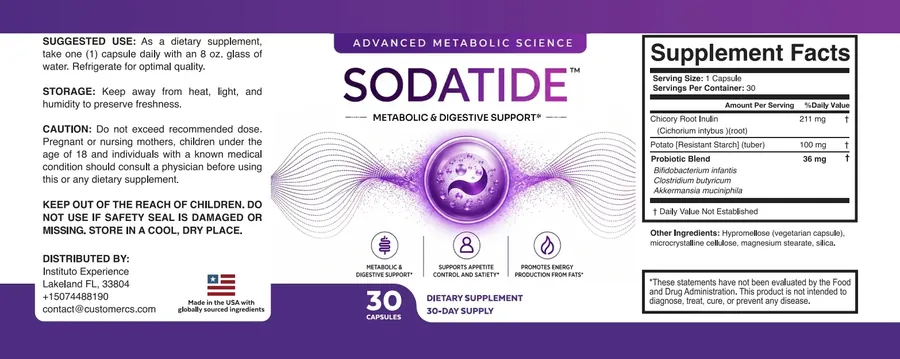
No published trial of Soda Tide itself exists. The Soda Tide research people quote is research on single ingredients, usually at grams a day, while one capsule holds 211 mg of inulin, 100 mg of resistant starch and a 36 mg probiotic blend. Treat each claim by asking what was tested, at what dose and who paid.
Written by the Sodatide editorial teamMedically reviewed by Dr. Pascale Carbonara, MD, PhysicianReview date: Published Last updated · 7 min read
At a glance
Key facts
Soda Tide research is a phrase that sounds like one thing and means several. Sometimes it means a trial of the product. More often it means a study of a plant fiber or a bacterium that happens to be on the label.
This page ranks the kinds of source you will meet, from a trial of the capsule down to an advertisement. It then sets the main ingredient studies next to one capsule and shows how to question any research claim.
- No trial of Soda Tide itself has been published. That is a gap, not a negative result.
- Ingredient studies used grams a day. One capsule has 211 mg of chicory root inulin and 100 mg of potato resistant starch.
- Probiotics are dosed in live cells (CFU). The label prints a 36 mg blend weight and no CFU count or strain codes.
- One widely quoted weight analysis of chicory fibers is a trade-press report, and it was funded by the BENEO Institute, with a BENEO employee as co-author.
- The NIH describes the average weight change across 15 probiotic trials, about 0.6 kg, as of questionable clinical significance.
- The FTC expects health claims to rest on research that matches the product's own dose and formula.
The direct question
Is there any Soda Tide research on the capsule itself?
Not that we can find. The sales page, the label and the desk brief name no trial, no sample size and no result for the capsule. No lab study of the finished product is published either.
This matters because a blend can behave differently from its parts. Doses, forms and the way the capsule breaks apart all change what reaches the gut. So when a page says 'clinically proven' next to the Soda Tide name, ask which clinical study it means. We found none to name.
Ranking the sources
What kinds of Soda Tide research claim will you meet, and how strong is each?
| Rung | What it is | Example for Soda Tide | What it can tell you |
|---|---|---|---|
| 1. Trial of the capsule | People take this exact product and are measured | None published | Would be direct evidence |
| 2. Reviews of trials | Many trials of one ingredient pooled | Resistant starch, 22 trials (Snelson 2019 RS2 meta-analysis) | How the ingredient behaves at the doses studied |
| 3. Single human trials | One study of one strain or dose | B. infantis 35624 in IBS (Whorwell 2006 B. infantis 35624 IBS); an Akkermansia pilot (Depommier 2019 Nat Med Akkermansia pilot) | A result for that strain at that dose only |
| 4. Agency documents | Safety or claim opinions | EFSA on inulin and stool frequency (EFSA 2015 chicory inulin claim); EFSA on pasteurized Akkermansia (EFSA 2021 pasteurised Akkermansia) | What an agency judged, within its limits |
| 5. Trade press | Reports of studies in industry media | Chicory fibers and weight (Reimer 2025 chicory ITF weight meta-analysis (trade report)) | A lead to follow, with funding to check |
| 6. Brand words | Labels, banners, ads | 'Advanced Metabolic Science' | Nothing about the capsule |
The higher the rung, the more weight a claim can carry. Most pages that use the phrase Soda Tide research stand on rungs five and six.
Doses side by side
How do the doses in Soda Tide research compare with one capsule?
Each row below is a study of an ingredient, never of the capsule. The last column shows what one capsule holds.
| Study | Length | Daily dose | Finding | One capsule |
|---|---|---|---|---|
| Chicory inulin, EFSA review | Days to weeks | 12 g | Stool frequency rose | 211 mg |
| Chicory fibers, 32 trials | Mostly up to 12 weeks | Median 10 g | Average weight down 0.97 kg | 211 mg |
| Resistant starch, 22 trials | 1 to 12 weeks | 8 to 66 g | Limited cardiometabolic benefit | 100 mg |
| B. infantis 35624, IBS trial | 4 weeks | 100 million CFU | Symptoms eased at this dose only | No strain, no CFU |
| Akkermansia pilot | 3 months | 10 billion cells | Insulin sensitivity rose; the weight change was not significant | No CFU, form not stated |
Read the dose column against the last column. A capsule holds a small fraction of every fiber dose in the table, and the label gives nothing to compare with the bacterial doses. Our inulin guide and Akkermansia guide go further.
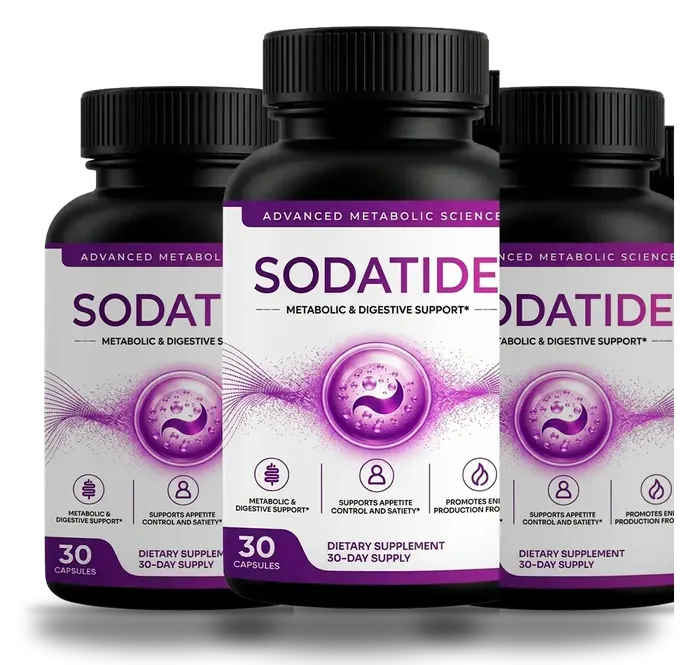
Want to read the label the research does not cover?The sales page shows the panel, the pack prices and the 60-day money-back policy.
See today's price and guaranteeWe are paid a commission when you order through our links. It adds nothing to your bill.
Who paid
Who paid for the Soda Tide research people quote?
Funding does not make a study wrong, but it tells you where to look harder. The chicory-fiber weight analysis was reported by a trade outlet. The report says the work was funded by the BENEO Institute and that a BENEO employee is a co-author. We flag it because an industry-linked funder and an industry-linked author are worth knowing about (Reimer 2025 chicory ITF weight meta-analysis (trade report)).
The EFSA documents come from a public agency panel, and the NIH fact sheets are public health sources (NIH ODS Probiotics (HP)). Neither is a sales document. When a page cites only supplier-funded work and brand words, take the claim as a lead, not a finding.
A fair standard
What would better Soda Tide research look like?
- A trial of the finished capsule, with a stated sample size, length and outcome measures.
- A live-cell count (CFU) per capsule at the end of shelf life.
- Strain codes for all three bacteria, and the Akkermansia form.
- An outside lab report for the lot, with a lab name and a test date.
- Results that include people who did not improve, and any side effects.
None of these is published today. The lot SOD-26/SO-4238 and CoA SOD-4238-26-SO are seller reference codes, not lab proof. You can ask for the rest at [email protected], the address printed on the label.
Your checklist
How can you test a Soda Tide research claim in an ad or a post?
What was tested?
The capsule, or only an ingredient? An ingredient study says little about a blend.
At what dose?
Grams a day in the study against milligrams in one capsule is a big gap.
For how long, in whom?
A four-week study in people with IBS does not describe everyone.
Who paid?
Check for supplier funding and for authors who work for a supplier.
Is there a link?
A real source names the journal, the year and the authors. A vague 'studies show' does not.
The FTC's view is that health claims need research that matches the product at its own dose and formula (FTC Health Products Compliance Guidance). For photos and star ratings, see our results and real proof guide.
FAQ
Frequently asked questions
Is there Soda Tide research?
There is research on its ingredients, not on the capsule. No trial of Soda Tide has been published. The ingredient studies used grams a day, and one capsule holds milligrams.
Has Soda Tide been clinically tested?
We found no clinical trial of the capsule. A claim of clinical proof should name the study, and we could not find one to name.
What does the EFSA say about inulin?
EFSA reviewed a claim that native chicory inulin helps maintain normal defecation by raising stool frequency. The studied amount was 12 g a day, far above the 211 mg in a capsule.
Do the Akkermansia studies apply to Soda Tide?
Only in part. The label does not say whether its Akkermansia is live or pasteurized, and the studies and the EFSA safety opinion treat the forms differently.
Can research on the ingredients predict results?
Not reliably. Dose, strain and form change results, and the capsule's blend has never been tested as a whole.
Is this medical advice?
No. It is general information. Ask your doctor or pharmacist whether the capsule suits you, especially if you take medicine or have a medical condition.
The short verdict
Our view
The honest summary of Soda Tide research is short. The capsule has not been studied. Its ingredients have, at doses far above one capsule, and the strongest findings are modest. That is a fair basis for curiosity and a poor basis for big promises.
Use the ladder. When a claim stands on rung five or six, treat it as a hint. When the brand publishes a trial, a CFU count and a lab report, the claim will deserve more weight, and we will update this page.
Sodatide is a dietary supplement. Like every supplement it is not FDA approved, and the FDA has not evaluated the statements on its label. It does not diagnose, treat, cure or prevent disease. If you have a condition, use medicine or feel unsure, check with your doctor or pharmacist before you begin.
Judge it with your own notesIf you try it, judge it by your own weekly notes.
See today's price and guaranteeWe are paid a commission when you order through our links. It adds nothing to your bill.