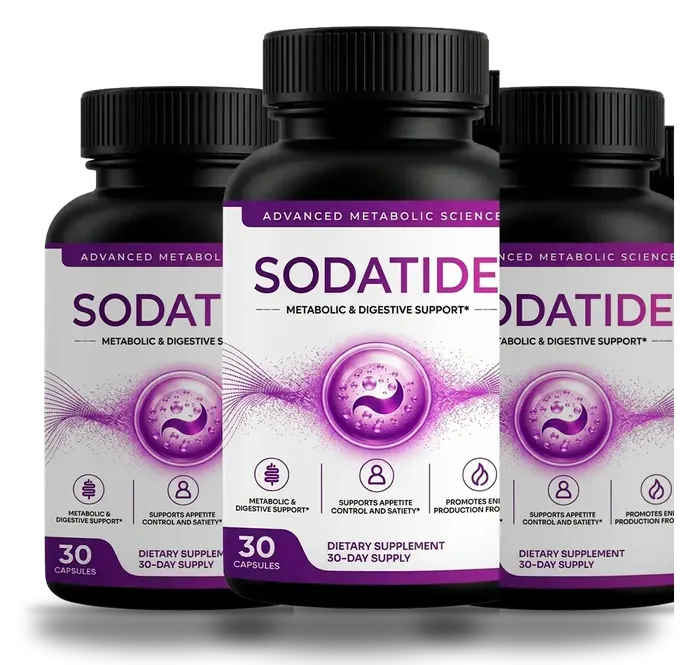
Benefits
Sodatide Benefits: Label Claims Sorted by Evidence
Expect a small fiber top-up and a daily habit from Sodatide, not weight loss.
The label claims metabolic and digestive support, appetite control and energy production from fats. The fiber studies used 5 to 66 grams a day, while each capsule holds 211 mg and 100 mg.
Find the full amounts on the ingredients page.
Written by the Sodatide editorial teamUpdated
The short answer
What are the real benefits of Sodatide?
The realistic benefits of Sodatide are modest: a small daily dose of two fermentable fibers and three probiotic species. Large changes in weight, appetite or energy are not supported at these amounts.
Every benefit below is graded by how much human evidence sits behind it, and at what dose. No trial has tested Sodatide itself, so all the evidence comes from studies of single ingredients.
Sodatide is a dietary supplement, not a drug and not a GLP-1 medicine. It is not a treatment for obesity, diabetes, IBS or any disease. The sales page goes further than its own label and disclaimer allow; we do not repeat its weight-loss and fat-burning claims (FTC Health Products Compliance Guidance) (FTC Gut Check weight-loss claims).
Front label
What does the Sodatide label claim on the front?
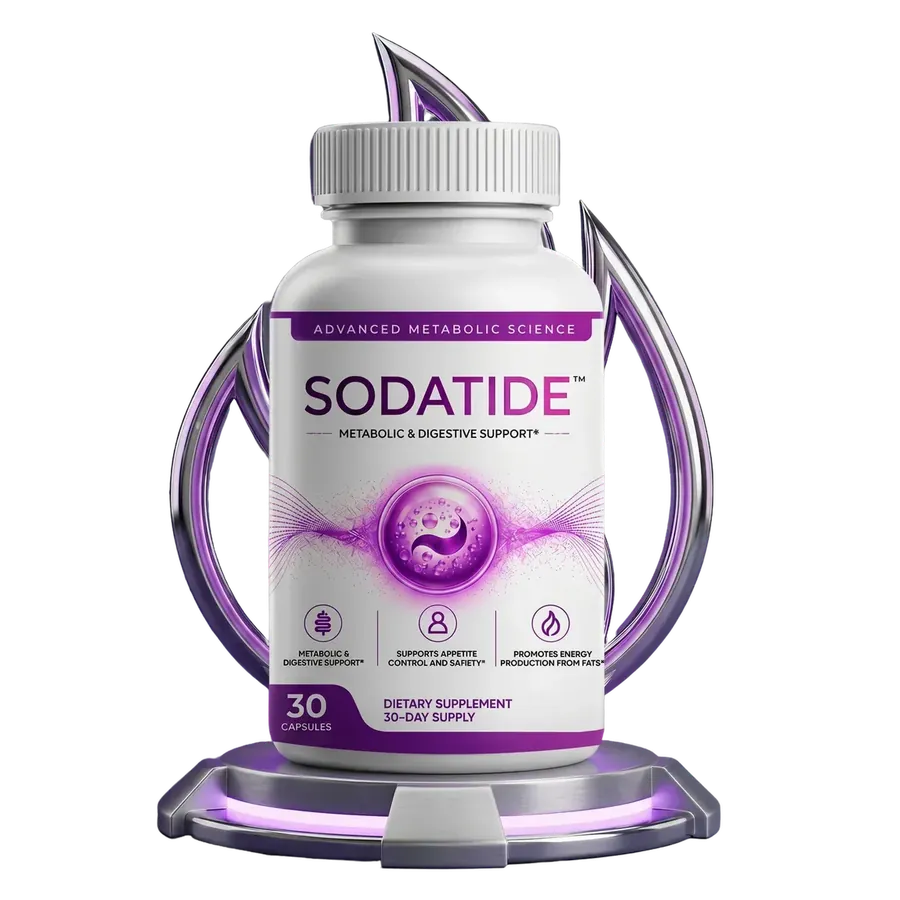
The front of the bottle makes three claims, each with an asterisk. They are the label's words, not findings from a study of the capsule.
"Metabolic & Digestive Support*"
The headline claim. It is broad, and it fits the structure and function claims that supplements may make without FDA review (FDA structure/function claims).
"Supports appetite control and satiety*"
A claim about feeling full. Fiber can add fullness at gram doses; the capsule holds about 0.3 grams.
"Promotes energy production from fats*"
A claim about how the body uses fat for fuel. We found no human study of these ingredients at these doses that measured it.
The asterisk leads to the standard notice: "These statements have not been evaluated by the Food and Drug Administration. This product is not intended to diagnose, treat, cure, or prevent any disease."
Claim by claim
How strong is the evidence for each Sodatide claim?
Weak for all three at the label's doses. Here is the detail.
| Label claim | Closest evidence | Studied dose | Sodatide | Our grade |
|---|---|---|---|---|
| Digestive support | Chicory inulin raised stool frequency; EFSA accepted the claim (EFSA 2015 chicory inulin claim) | 12 g a day | 211 mg | Real effect, far below dose |
| Metabolic support | Resistant starch showed "limited cardiometabolic benefit" across 22 trials (Snelson 2019 RS2 meta-analysis) | 8 to 66 g a day | 100 mg | Limited even at grams |
| Appetite and satiety | Satiety results for resistant starch were mixed in 3 studies and not pooled (Snelson 2019 RS2 meta-analysis) | Grams a day | About 0.3 g total fiber | Weak |
| Energy from fats | No study at these doses measured fat use for energy | Not published | No match | No evidence found |
Federal guidance says claims need research that matches the product's own dose, formula and ingredient mix (FTC Health Products Compliance Guidance). None of the studies above used a capsule like this one.
Fibers
What benefits do inulin and resistant starch have in studies?
The clearest fiber benefit is regularity, and it needs grams. EFSA found that 12 grams a day of native chicory inulin increased stool frequency in 6 studies (EFSA 2015 chicory inulin claim).
For weight, a 2025 review pooled 32 trials of chicory fibers at a median of 10 grams a day. Average weight fell by 0.97 kg compared with placebo, under 1 kg. An ingredient supplier funded the work (Reimer 2025 chicory ITF weight meta-analysis (trade report)).
For blood sugar, a 2023 review found resistant starch lowered fasting glucose and insulin in people with type 2 diabetes, at about 6 to 40 grams a day (Pugh 2023 RS glycemic meta-analysis). It found no effect in prediabetes. A supplement is not a diabetes treatment; any change in your plan belongs with your doctor.
More on each fiber sits on the chicory inulin and resistant starch pages.
Probiotics
What benefits do Sodatide's probiotics have in research?
Probiotic benefits are tied to a named strain at a known dose, and the label gives neither. That makes any benefit hard to predict.
- B. infantis: one strain, 35624, eased IBS symptoms at 100 million CFU; higher and lower doses did not (Whorwell 2006 B. infantis 35624 IBS).
- Akkermansia: in a 32-person pilot, the pasteurized form improved insulin sensitivity; weight change was not significant, and the live form changed few markers (Depommier 2019 Nat Med Akkermansia pilot).
- C. butyricum: one strain, MIYAIRI 588, has decades of use in Japan, and safety depends on the strain (Miyarisan CBM 588 novel food dossier) (ACNFP C. butyricum TO-A paper).
Across probiotic trials, NIH found an average weight change of 0.6 kg, of "questionable clinical significance" (NIH ODS Probiotics (HP)). The Akkermansia page covers that pilot study in depth.
By strength
Which Sodatide benefits are realistic, and which are not?
Realistic
- A small, steady fiber top-up of about 0.3 grams a day
- Three probiotic species delivered daily, in an unknown live count
- A daily cue that can anchor better eating habits
- A trial you can judge inside the 60-day refund window
Not supported at these doses
- Noticeable weight loss
- Strong appetite control or lasting fullness
- More energy from stored fat
- Any GLP-1-like or drug-like effect

The name
Does Sodatide have the benefits of a GLP-1 medicine?
No. Sodatide is not a GLP-1 medicine and is not an alternative to one. It contains no drug, only two fibers and three bacteria.
GLP-1 medicines are prescription drugs that copy a gut hormone, and they work in ways a fiber capsule cannot (NIDDK prescription obesity medicines). The resemblance between the name Sodatide and drug names like semaglutide is only a sound.
Talk to a licensed clinician. FDA warns against buying GLP-1 drugs from unlicensed online sellers (FDA unapproved GLP-1 concerns).
Where the gains are
How can you get the fiber benefits Sodatide's ingredients were studied for?
Eat fiber-rich food daily. That is how you reach the gram amounts behind the research.
Adults need about 21 to 38 grams of fiber a day (Mayo Clinic fiber). Onions, garlic, leeks, oats and bananas contain natural fructans and starches that feed gut bacteria. Cooked and cooled potatoes and slightly green bananas supply resistant starch.
Build up a few grams a week to avoid gas, as the how-to-use guide explains. A capsule can sit beside those foods; it cannot stand in for them.
Bottom line
What is the honest summary of Sodatide's benefits?
- Three front claims, all label claims, none tested on the capsule
- Fiber benefits are real at 5 to 66 grams; the capsule holds 0.3
- Probiotic benefits depend on strain and CFU, neither printed
- No drug, no GLP-1 effect, no disease treatment
- Food fiber is where the measurable gains are
FAQ
Sodatide benefits FAQ
Does Sodatide really work for weight loss?
No study shows Sodatide causes weight loss, and the label does not claim it. Its fibers were studied at grams a day, where average weight change was under 1 kg (Reimer 2025 chicory ITF weight meta-analysis (trade report)). Each capsule holds milligrams. Diet, activity and medical care are what change weight.
Does Sodatide help with appetite and feeling full?
The label claims it "supports appetite control and satiety", but the evidence is weak. Fiber can add fullness at gram doses, and even then results for resistant starch were mixed (Snelson 2019 RS2 meta-analysis). One capsule supplies about 0.3 grams of fiber.
Can Sodatide help with bloating or regularity?
Regularity benefits from inulin were shown at 12 grams a day (EFSA 2015 chicory inulin claim), about 57 capsules' worth. At 211 mg, a noticeable change is unlikely. Ongoing bloating or a big change in bowel habits should be checked by a doctor.
Does Sodatide lower blood sugar?
There is no evidence that Sodatide lowers blood sugar. Resistant starch helped fasting glucose in type 2 diabetes at about 6 to 40 grams a day (Pugh 2023 RS glycemic meta-analysis); the capsule holds 100 mg. If you have diabetes, keep to the plan your doctor set.
What does "energy production from fats" mean on the Sodatide label?
It is a front-label claim that the body uses fat for fuel. We found no human study of these ingredients at these doses that measured it. Like the other claims, it has not been evaluated by the FDA.
Is Sodatide better than eating more fiber?
No. Mayo Clinic says whole foods are generally better than fiber supplements (Mayo Clinic fiber). A cup of beans gives many grams of fiber; one capsule gives about 0.3 grams. The capsule can only add to good food.
Are the Sodatide benefits proven in clinical trials?
Sodatide itself has not been tested in a published trial. The research comes from single ingredients at much larger doses. The FTC says that kind of evidence does not support claims for a product at its own dose (FTC Health Products Compliance Guidance).
Who wrote this
Written and reviewed by
Plain-language pages built from the bottle label, the order page and linked public health sources such as NIH, FDA and CDC.
Last updated . Read our editorial standards and how we check reviews. This website is run by a U.S. retail desk for Sodatide, not by the manufacturer. We are paid a commission when you buy through our order links.
Keep reading
More about Sodatide
How it works
Prebiotics feed bacteria, probiotics add them: how Sodatide's five ingredients are meant to work, and where the doses fall short.
Read more
Ingredients
All five Sodatide ingredients, their label amounts, and the gram and CFU doses used in research.
Read more
Side effects
Mild gas is the likely effect. Weak immunity, pregnancy and medical conditions are the real reasons to ask first.
Read moreLicensed U.S. retail desk for Sodatide
Ready to try Sodatide?
Pick a pack. One capsule a day; every pack covers the whole 60-day window.
- Secure checkout
- 60-day money-back window
- Free U.S. shipping on 3+ bottles