Ingredient profile
Bifidobacterium infantis in Sodatide: What the Label Leaves Out
Sodatide lists Bifidobacterium infantis first in a 36 mg probiotic blend, so it weighs at most 36 mg. The label prints no strain code and no CFU count. The best-known trial tested strain 35624 in women with IBS: only 100 million CFU a day beat placebo, while lower and higher doses did not (Whorwell 2006 B. infantis 35624 IBS). That result cannot be applied to an unnamed strain.
Written by the Sodatide editorial teamUpdated
The basics
What is Bifidobacterium infantis?
Bifidobacterium infantis is a gut bacterium. Its full name is Bifidobacterium longum subspecies infantis, and the name points to infants, whose guts often carry it.
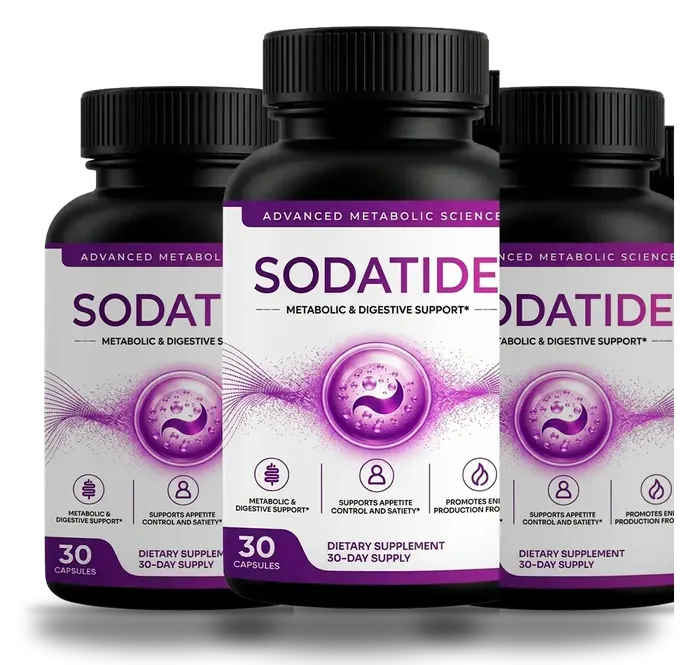
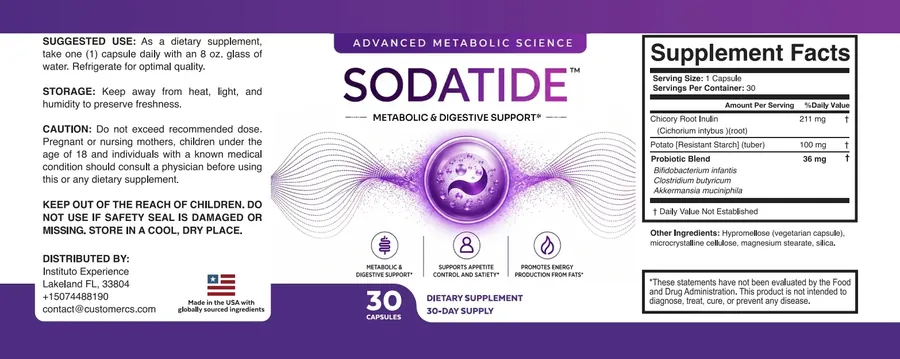
Sodatide's label lists it as the first of three bacteria in a "Probiotic Blend" of 36 mg. The other two are Clostridium butyricum and Akkermansia muciniphila. The label gives the species name only.
Bacteria sold as probiotics are named in three parts: genus, species and strain. The strain is a code such as 35624. Two strains of the same species can act very differently in the body, which is why the NIH says probiotic effects are strain-specific (NIH ODS Probiotics (HP)).
| Label name | Bifidobacterium infantis |
|---|---|
| What it is | Bifidobacterium longum subsp. infantis · Probiotic bacterium |
| Position on the label | 1 of 3 in the blend (labels list blend ingredients from most to least by weight) |
| Amount per serving (1 capsule) | In the 36 mg probiotic blend |
| Amount used in research | One strain (35624) at 100 million CFU helped IBS; no strain or CFU on this label |
| Strength of evidence | Strain-specific, IBS only |
| Why it is used | A gut bacterium studied for IBS symptoms (specific strain) |
| Main caution | Probiotics are not for people who are very ill or immunocompromised without medical advice. |
Dose check
How much B. infantis is in a Sodatide capsule?
The honest answer is "at most 36 mg, live cell count unknown." Blends list their parts from most to least by weight, and the label gives only the blend total (FDA labeling guide ch. IV). B. infantis is listed first, so it could be most of the 36 mg, or a little more than a third.
| Detail | Sodatide label | IBS trial (2006) |
|---|---|---|
| Strain | Not published | 35624 |
| Amount stated as | Weight: part of a 36 mg blend | Live cells (CFU) |
| Live cells per day | Not published | 1 million, 100 million or 10 billion |
| Dose that beat placebo | Cannot be compared | 100 million CFU only |
| Other bacteria in the capsule | Two more, plus two fibers | None; tested alone |
| Who took it | Adults, per the label | 362 women with IBS, for 4 weeks |
Milligrams do not tell you how many cells are alive. Federal rules let a label give total weight, and that weight includes dead cells. The NIH advises looking for a CFU count that holds until the end of shelf life (NIH ODS Probiotics (HP)).
At a glance
B. infantis research in five numbers
Evidence
What did the B. infantis IBS trial find?
It found relief from IBS symptoms at one dose only. In 2006, Whorwell and colleagues gave 362 women with irritable bowel syndrome strain 35624 or a dummy pill for 4 weeks (Whorwell 2006 B. infantis 35624 IBS).
The results in plain words
- At 100 million CFU a day, pain, bloating and bowel habits improved more than on placebo.
- Overall relief was more than 20 percentage points better than placebo at that dose.
- At 1 million CFU a day, there was no clear benefit.
- At 10 billion CFU a day, there was no clear benefit either. The authors noted that capsule had a formulation problem.
- No significant side effects were reported.
Why this matters for a blend
The trial shows that both strain and dose decided the outcome. More cells were not better. A product that names no strain and prints no count cannot borrow this result.
Across many products, the NIH found probiotics lowered the risk of lasting IBS symptoms by about 21%, but rated that evidence low quality (NIH ODS Probiotics (HP)). NCCIH adds that for most conditions, nobody yet knows which probiotic helps, how much, or for whom (NCCIH Probiotics).
Weight and metabolism
Does B. infantis help with weight or appetite?
No study we found tested B. infantis alone for weight or appetite. The 2006 trial measured IBS symptoms, not body weight.
For probiotics in general, the NIH pooled 15 trials and found an average loss of about 0.6 kg. It called that of "questionable clinical significance" (NIH ODS Probiotics (HP)). The NIH weight-loss fact sheet says effects depend on strain, dose and length of use (NIH ODS Weight-loss supplements (HP)).
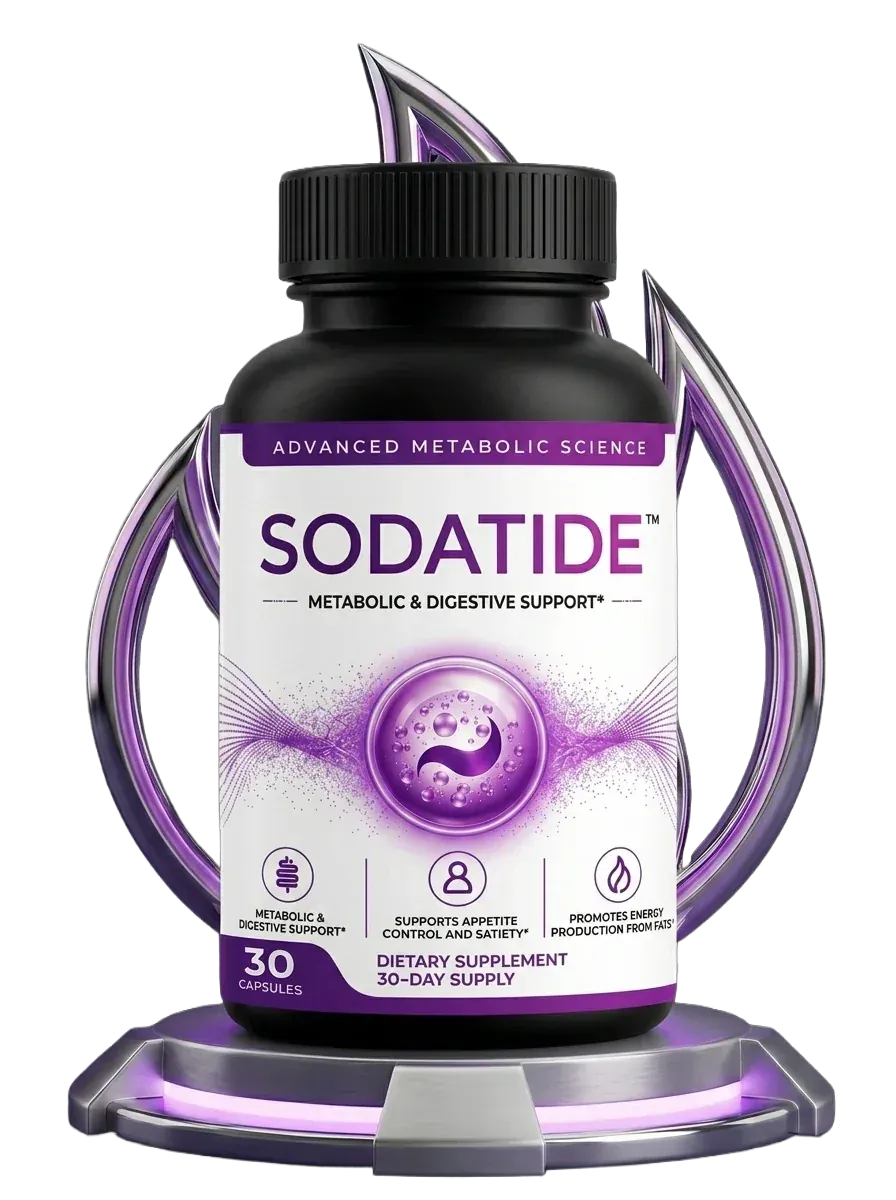
Sodatide's front label says "Metabolic & Digestive Support*". The asterisk leads to the standard note that the FDA has not evaluated the statement. No claim on the label is tied to B. infantis by name.
The how Sodatide works page covers what the whole formula can and cannot be expected to do.
Safety
Is B. infantis safe, and who should be careful?
For most healthy adults, B. infantis appears well tolerated; the 2006 trial reported no significant side effects (Whorwell 2006 B. infantis 35624 IBS). The risk rises in people who are very ill or have a weakened immune system, where probiotics have caused rare bloodstream infections (NIH ODS Probiotics (HP)).
In 2023 the FDA warned that probiotics given to hospitalized preterm infants can cause serious, sometimes fatal infections. One of the products named contained a B. infantis strain (FDA 2023 probiotics preterm infants). Sodatide is labeled for adults; keep it away from infants and children.
Early days may bring mild gas while the gut adjusts. The full list, including the fiber side, is on the Sodatide side effects page.
Before you buy
What should you ask the brand about its B. infantis?
Ask for the strain code and the live cell count. Those two facts decide whether any study applies. The label's distributor email is [email protected].
Which strain?
A code such as 35624 links the bacteria to published research. Without it, no trial can be matched.
How many CFU?
Ask for live cells per capsule at the end of shelf life, not at the time of making.
Is it tested?
Ask whether a lab checked the count for your lot. The testing and quality page lists what is published today.
The bottle says to refrigerate for optimal quality. Live bacteria tend to keep better cold, so the fridge is the safe place for the bottle.
Our view
Is the B. infantis in Sodatide worth paying for?
We cannot tell, and neither can the label. B. infantis has a real research record in IBS, but only for one named strain at one count.
Pros
- A well-known gut species with human research
- Listed first in the blend, so it is the largest of the three bacteria
- One capsule a day, kept in the fridge
Cons
- No strain code, so no trial can be matched
- No CFU count, so the live dose is unknown
- The research is for IBS, not weight
Keep exploring
Which Sodatide ingredients sit next to B. infantis?
B. infantis shares the blend with two other bacteria. Clostridium butyricum comes second, and its safety depends on the strain. Akkermansia comes third and has one small pilot study. The two fibers, inulin and resistant starch, carry printed amounts. The full Sodatide ingredient guide compares all five.
FAQ
Bifidobacterium infantis in Sodatide: common questions
How much Bifidobacterium infantis is in Sodatide?
At most 36 mg by weight, because it is the first of three bacteria in a 36 mg blend. The label gives no live cell count (CFU), so the real dose of living bacteria is unknown. Weight on a probiotic label also includes dead cells (NIH ODS Probiotics (HP)).
What strain of B. infantis does Sodatide use?
The label does not say. It names only the species, Bifidobacterium infantis, with no strain code. Research results belong to specific strains, such as 35624 in the 2006 IBS trial (Whorwell 2006 B. infantis 35624 IBS). Email [email protected] and ask the brand which strain it uses.
Does Bifidobacterium infantis help IBS?
One strain did, at one dose. In a trial of 362 women with IBS, strain 35624 at 100 million CFU a day eased pain and bloating better than placebo, while 1 million and 10 billion CFU did not (Whorwell 2006 B. infantis 35624 IBS). Talk to a doctor about IBS care.
Is B. infantis good for weight loss?
There is no good evidence that it is. No trial we found tested B. infantis alone for weight. Probiotics as a group showed an average change of about 0.6 kg, which the NIH calls of questionable clinical significance (NIH ODS Probiotics (HP)).
Can children take a supplement with B. infantis like Sodatide?
Sodatide's label says children under 18 should see a physician before use. The FDA has warned that probiotics can cause serious infections in hospitalized preterm infants (FDA 2023 probiotics preterm infants). Never give an adult probiotic capsule to a baby or child without a pediatrician's advice.
Why does Sodatide need refrigeration if it has B. infantis?
The label says to refrigerate for optimal quality. Live bacteria generally keep better when cold, though the brand does not publish shelf-life cell counts. Keep the closed bottle in the fridge, away from heat, light and moisture.
Is B. infantis the same as Bifidobacterium longum?
B. infantis is a subspecies of Bifidobacterium longum. Its full name is Bifidobacterium longum subspecies infantis. Sodatide's label uses the short name, Bifidobacterium infantis, and gives no strain code.
Who wrote this
Written and reviewed by
Plain-language pages built from the bottle label, the order page and linked public health sources such as NIH, FDA and CDC.
Last updated . Read our editorial standards and how we check reviews. This website is run by a U.S. retail desk for Sodatide, not by the manufacturer. We are paid a commission when you buy through our order links.
Keep reading
More about Sodatide
Clostridium butyricum
A butyrate-making bacterium with a long record in Japan. Its safety is judged strain by strain, and Sodatide names none.
Read moreAkkermansia muciniphila
One 32-person pilot, a pasteurized form, and an EFSA safety opinion. What it means for Sodatide's unstated Akkermansia.
Read moreTesting & quality
What the Sodatide label publishes, what it leaves out, what each badge means, and what to ask for.
Read moreLicensed U.S. retail desk for Sodatide
Ready to try Sodatide?
Pick a pack. One capsule a day; every pack covers the whole 60-day window.
- Secure checkout
- 60-day money-back window
- Free U.S. shipping on 3+ bottles