Health guide
Gut Health Guide: Fiber, the Microbiome, Prebiotics and Probiotics
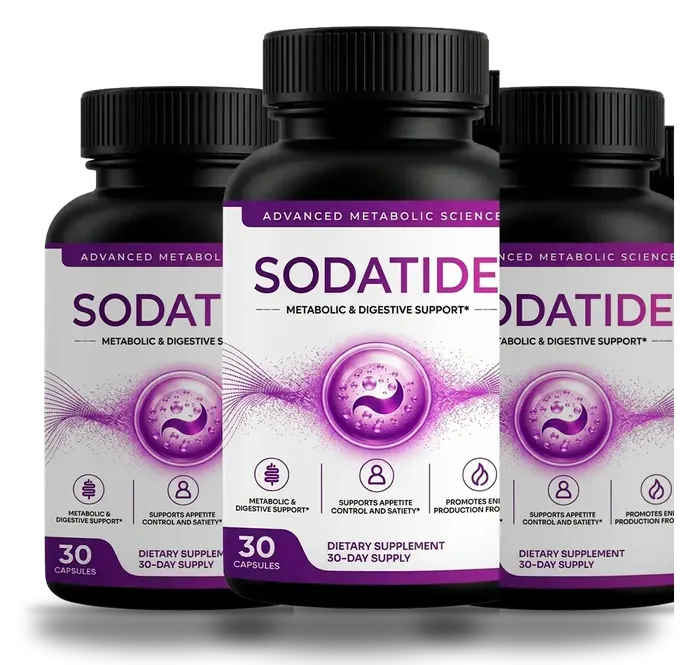
Most adults need about 21 to 38 grams of fiber a day, and whole foods are the best source. Prebiotics are fibers that feed gut bacteria; probiotics are live bacteria. Beans, oats, vegetables, fruit and fermented foods do most of the work. A capsule like Sodatide adds about 0.3 grams of fiber. See a doctor for blood in the stool or ongoing belly pain.
Written by the Sodatide editorial teamUpdated
The short version
What does good gut health mean in plain terms?
Good gut health mostly means regular, comfortable digestion and a varied diet that feeds the bacteria living in your colon. Fiber is the main lever you control, and food supplies far more of it than any capsule.
The small intestine absorbs most nutrients. What it cannot digest, mainly fiber, moves on to the colon, where trillions of bacteria break it down.
Good signs are simple: a steady bowel schedule, no straining, and gas that stays mild.
No single food, pill or test defines a healthy gut. The useful advice is plain: eat more plants, add fiber slowly and drink enough water.
Fiber
How much fiber do adults need each day?
Adults need about 21 to 38 grams of fiber a day, depending on age and sex, according to MedlinePlus (MedlinePlus dietary fiber). Mayo Clinic gives the National Academy of Medicine figures below and adds that whole foods are generally better than fiber supplements (Mayo Clinic fiber).
| Group | Age 50 or younger | Age 51 or older |
|---|---|---|
| Women | 25 g a day | 21 g a day |
| Men | 38 g a day | 30 g a day |
| One Sodatide capsule | About 0.3 g of fiber (211 mg inulin plus 100 mg resistant starch) | |
Soluble fiber (oats, beans, apples) forms a gel. Insoluble fiber (wheat bran, nuts, vegetable skins) adds bulk. Most plants have both.
Raise fiber over a few weeks, not overnight. A sudden jump can cause gas, bloating, cramps or loose stools, and drinking enough fluid helps (MedlinePlus dietary fiber). These effects often ease as gut bacteria adjust.
The microbiome
What is the gut microbiome, and why does fiber feed it?
The gut microbiome is the community of bacteria, yeasts and other microbes living mainly in your colon. Fiber is their main food, because your own body cannot digest it.
When bacteria ferment fiber, they make short-chain fatty acids such as butyrate. These compounds help fuel the cells lining the colon. That is one reason fiber-rich diets are linked to better gut health.
The U.S. Dietary Guidelines for 2025 to 2030 say vegetables, fruits, fermented foods and high-fiber foods support a diverse microbiome (Dietary Guidelines 2025-2030). Variety matters. Different bacteria prefer different fibers, so a mix of plants feeds a wider range of them.
- Each person's microbiome is different, shaped by diet, age, medicines and genes.
- Diet changes shift the microbiome within days, which is encouraging.
Two different things
What is the difference between prebiotics and probiotics?
Prebiotics are fibers that feed the bacteria already in your gut. Probiotics are live microbes you swallow, in food or capsules. One is the food; the other is the bacteria.
Food for your bacteria
Examples: inulin from chicory root, resistant starch from cooled potatoes or green bananas, and fibers in onions, garlic, oats and beans. Studied at gram doses. Sodatide's two fibers, chicory inulin and resistant starch, belong here.
Live bacteria you take in
Examples: yogurt with live cultures, kefir, some sauerkraut, and capsules. Dosed in colony-forming units (CFU), live cells, often 1 to 10 billion per dose (NIH ODS Probiotics (HP)). Effects depend on the exact strain.
A product that combines both is sometimes called a synbiotic. Sodatide is one example: two fibers plus a 36 mg blend of three bacteria. The label prints no CFU count, so its probiotic dose cannot be compared with any study.
NCCIH, part of the NIH, says different probiotics may have different effects, and for most conditions it is not known which ones help or how much (NCCIH Probiotics). The guide on choosing a probiotic turns that into a checklist.
Food sources
Which foods give the most fiber and gut-friendly bacteria?
Beans, lentils, whole grains, vegetables, fruit, nuts and seeds give the most fiber. Yogurt and kefir with live cultures are the easiest food sources of probiotics.
| Food | Portion | Fiber, about | Same as Sodatide capsules |
|---|---|---|---|
| Cooked lentils | 1 cup | 15 g | About 50 |
| Black beans | 1 cup, cooked | 15 g | About 50 |
| Raspberries | 1 cup | 8 g | About 26 |
| Rolled oats | 1 cup, cooked | 4 g | About 13 |
| Pear with skin | 1 medium | 5.5 g | About 18 |
| Broccoli | 1 cup, cooked | 5 g | About 16 |
| Chia seeds | 1 tablespoon | 4 g | About 13 |
Cooking and then cooling potatoes, rice or pasta raises their resistant starch, and a green-tipped banana has more than a ripe one.
The article on fiber foods vs fiber capsules compares costs and amounts in more detail.
A gentle plan
How can I add fiber without gas and bloating?
Add about 3 to 5 grams a week and drink more water as you go. Small steps let your gut bacteria adjust, so gas stays mild.
Week 1
Swap white bread for whole grain and add one piece of fruit a day.
Week 2
Add half a cup of beans or lentils to a soup, salad or rice dish.
Week 3
Make half your plate vegetables at dinner and snack on nuts.
Inulin is a type of fructan, and fructans are FODMAPs, a group of carbohydrates that can trigger symptoms in people with IBS (Monash FODMAP high/low foods). If onion, garlic or wheat bother you, go slower with chicory-based fibers. In a small trial, healthy adults tolerated up to 10 grams of native inulin a day, with gas the most common complaint (Bonnema 2010 inulin GI tolerance).
When to see a doctor
Which gut symptoms need a doctor rather than a supplement?
Blood in the stool, weight loss you did not plan, ongoing belly pain or a big change in bowel habits all need a medical checkup. No fiber or probiotic should delay that visit.
Blood in or on the stool, black tarry stools, unplanned weight loss, belly pain that keeps coming back, trouble swallowing, vomiting, fever with diarrhea, or a change in bowel habits that lasts more than a few weeks. Adults due for colon cancer screening should not skip it.
A doctor can rule out IBS, celiac disease and inflammatory bowel disease.
Probiotics also carry more risk for some people. Serious infections have been reported in people who are severely ill or have weak immune systems (NIH ODS Probiotics (HP)). Ask first if so.
Sodatide in context
Where does a capsule like Sodatide fit in gut health?
Sodatide fits as a small add-on at most, not as the base of gut health. One capsule supplies about 0.3 grams of fiber, roughly 1% of a 30-gram daily target.
Its label claims "Metabolic & Digestive Support". That is the brand's claim, and the FDA has not evaluated it. Sodatide itself has not been tested in a published trial. The fibers inside are real and well studied, but at grams, not milligrams.
If you want to try it, follow the label: As a dietary supplement, take one (1) capsule daily with an 8 oz. glass of water. Refrigerate for optimal quality. Keep the habits above as the main plan. The Supplement Facts page shows the full label.
Gut health in five numbers
Which gut health numbers are worth remembering?
FAQ
Gut health questions
How much fiber should I eat a day for gut health?
Most adults need about 21 to 38 grams of fiber a day. Women 50 or younger need about 25 grams and men 50 or younger about 38 grams, with slightly lower targets after 50. Most Americans eat far less, so adding beans, oats, fruit and vegetables is the first step.
Are prebiotics or probiotics better for gut health?
Neither is better in general; they do different jobs. Prebiotic fibers feed the bacteria you already have, and food supplies them in grams. Probiotics add live bacteria, and their effects depend on the exact strain and dose. For most people, a fiber-rich diet comes first.
Can a prebiotic capsule replace eating vegetables?
No, a prebiotic capsule cannot replace vegetables. One Sodatide capsule gives about 0.3 grams of fiber, while one cup of cooked broccoli gives about 5 grams. Whole foods also bring vitamins, minerals and many fiber types that a capsule does not.
Why does more fiber make me bloated?
Gut bacteria make gas when they ferment fiber, so a fast increase often causes bloating. Add fiber slowly over a few weeks and drink more fluid. If certain foods such as onion, garlic or wheat always trigger symptoms, ask a doctor about IBS and a low-FODMAP approach.
Does Sodatide help gut health?
Sodatide's label claims metabolic and digestive support, but no trial of the product has been published. It contains two real prebiotic fibers at milligram amounts and a 36 mg probiotic blend with no CFU count. Food supplies the fiber amounts that studies used.
When is a gut problem serious?
Blood in the stool, black stools, unplanned weight loss, ongoing belly pain, trouble swallowing or a lasting change in bowel habits are reasons to see a doctor soon. These signs need a checkup, not a supplement, even if they seem mild.
Who wrote this
Written and reviewed by
Plain-language pages built from the bottle label, the order page and linked public health sources such as NIH, FDA and CDC.
Last updated . Read our editorial standards and how we check reviews. This website is run by a U.S. retail desk for Sodatide, not by the manufacturer. We are paid a commission when you buy through our order links.
Keep reading
More about Sodatide

Fiber foods vs capsules
Daily fiber targets, a table of everyday foods by grams, how a capsule compares, and how to add fiber without the bloating.
Read more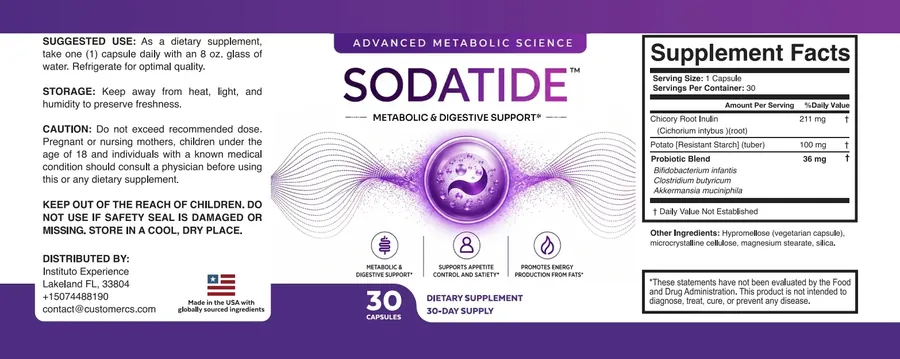
Chicory root inulin
Sodatide's largest ingredient, 211 mg of chicory inulin, next to the 5 to 12 grams a day used in studies.
Read moreChoosing a probiotic
A six-point checklist for any probiotic label, with a fair scorecard for Sodatide.
Read moreLicensed U.S. retail desk for Sodatide
Ready to try Sodatide?
Pick a pack. One capsule a day; every pack covers the whole 60-day window.
- Secure checkout
- 60-day money-back window
- Free U.S. shipping on 3+ bottles