Appetite claims
Over-the-Counter Appetite Suppressants and Where Sodatide Fits
'Appetite suppressant' is a marketing phrase on supplement pages, and the FDA does not approve supplements before sale. Sodatide's sales page says it supports appetite control and satiety, but no study tested that, and one capsule holds about 0.3 g of fiber. The NIH notes that we know little about whether such supplements work.
Written by the Sodatide editorial teamMedically reviewed by Dr. Pascale Carbonara, MD, PhysicianReview date: Published Last updated · 8 min read

At a glance
Key facts
Type 'appetite suppressant' into a store or a search bar and you get pills, capsules, gummies, teas, powders and prescription drugs all mixed together. Most of the supplement products use soft words like 'supports' and 'helps'. Few say how large the effect might be.
This page does three things. It explains what the phrase means on a supplement, checks Sodatide's own appetite wording against the research behind its ingredients, and gives you a checklist for any over-the-counter product that makes a similar promise.
- Sodatide's front label reads 'Metabolic & Digestive Support*'. The sales page adds 'Supports appetite control and satiety*'. Both carry an asterisk.
- No published trial tested Sodatide for appetite, fullness or weight.
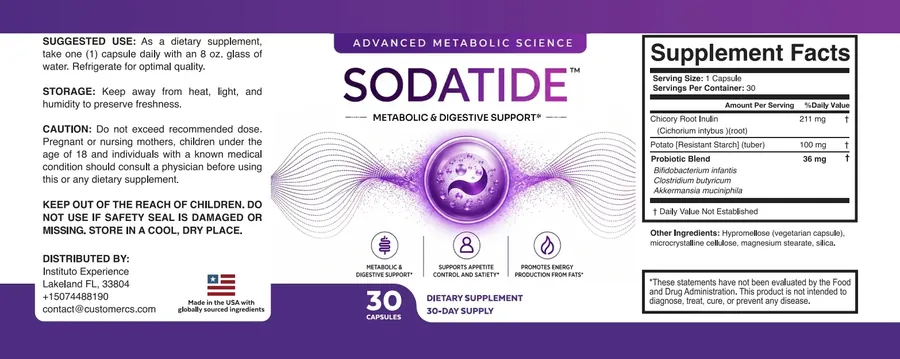
- One capsule has about 0.3 g of fiber (inulin 211 mg plus resistant starch 100 mg). A typical adult target is 21 to 38 g of fiber a day.
- The NIH notes how little is known about whether weight-loss supplements work.
- Across 15 probiotic trials, body weight changed by about 0.6 kg on average, which the NIH calls of questionable clinical significance.
- Prescription appetite and weight medicines need a prescriber. Sodatide is not one.
The words
What does 'appetite suppressant' mean on a supplement page?
Not much, legally. A dietary supplement can describe how an ingredient supports a normal body function, with a disclaimer that the FDA has not evaluated the statement, but it may not claim to diagnose, treat, cure or prevent a disease (FDA structure/function claims). 'Supports appetite control' sits on the soft side of that line.
The FDA also does not approve supplements before they go on sale (FDA 101 Dietary Supplements). So there is no regulator stamp behind the phrase. The weight of proof falls on the maker, and the FTC expects health claims to rest on research that matches the product's own dose and formula (FTC Health Products Compliance Guidance).
That is a useful lens. When you read any appetite claim, ask whether anyone tested this product at this dose, and what the size of the effect was.
The claim
Does Sodatide claim to suppress appetite?
It makes a softer claim. The front label says 'Metabolic & Digestive Support*'. On the sales page two more lines appear: 'Supports appetite control and satiety*' and 'Promotes energy production from fats*'. Follow the asterisk and you reach the stock FDA notice: the statements are unevaluated, and the product is not meant to diagnose, treat, cure or prevent disease.
Our reading: these are the brand's claims, not findings. We do not repeat the sales page's weight and fat lines as fact. Sodatide is a supplement, not an appetite medicine, not a GLP-1 drug and not a treatment for obesity.
The research
What does fiber research say about feeling full?
Fiber can add fullness at gram doses, and even then the data are mixed. A 2019 review of resistant starch trials found satiety results were mixed in 3 studies and did not pool them (Snelson 2019 RS2 meta-analysis). Inulin's best-supported effect is on stool frequency, at 12 g a day, not on hunger (EFSA 2015 chicory inulin claim).
| Ingredient | In one capsule | Studied amount | What studies measured |
|---|---|---|---|
| Chicory inulin | 211 mg | 12 g a day | Stool frequency (EFSA) |
| Chicory fibers, weight trials | 211 mg | Median 10 g a day | Average weight change of 0.97 kg across 32 trials |
| Resistant starch | 100 mg | 8 to 66 g a day | Limited metabolic change across 22 trials |
| Probiotics, weight trials | Blend 36 mg, no CFU | Billions of CFU | About 0.6 kg across 15 trials |
The 0.97 kg figure comes from trade-press coverage of an analysis funded by an ingredient supplier (Reimer 2025 chicory ITF weight meta-analysis (trade report)), and the NIH describes the probiotic change as of questionable clinical significance (NIH ODS Probiotics (HP)). A Sodatide capsule is a small fraction of any of these doses.
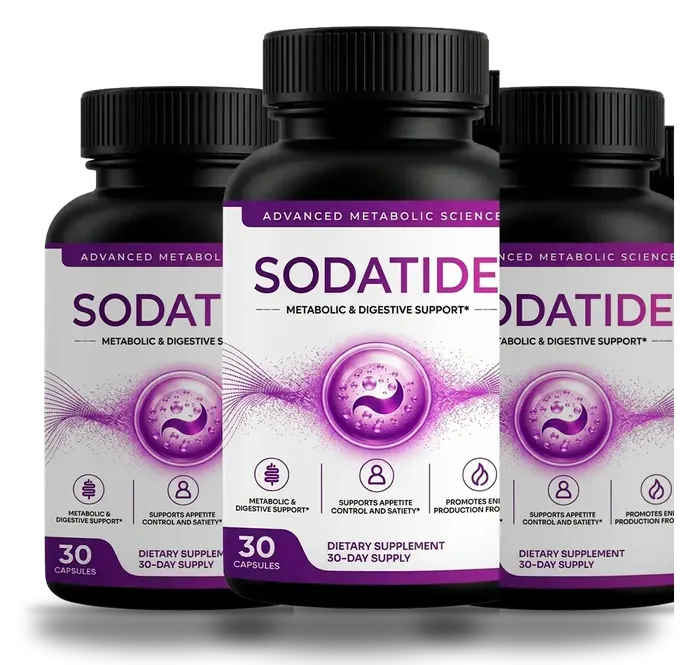
Reading the claim for yourself?The sales page shows the claim in the brand's own words, plus the price and money-back terms.
See today's price and guaranteeWe are paid a commission when you order through our links. It adds nothing to your bill.
Safety
Are over-the-counter appetite suppressants safe?
It depends on the product, and 'natural' does not settle it. The FDA has reported hundreds of weight-loss products, sold as supplements, that secretly held a drug, sibutramine, which is why lab reports and open labels matter here (FDA 6 tip-offs health fraud). Nothing suggests that of Sodatide, whose label names two fibers, three bacteria and capsule materials.
The NIH advises talking to a clinician before using weight-loss supplements, and the NIDDK says not to combine weight products unless prescribed (NIDDK prescription obesity medicines). On medicine for diabetes, blood pressure or weight? Ask first.
People often search for side effects of appetite pills. For Sodatide, the likely one is mild gas or bloating from the fibers. The bigger caution is for people with weak immunity, because of the live bacteria.
Checklist
How do you read any appetite-suppressant label?
| Check | What a clear label shows | Sodatide |
|---|---|---|
| Amount of each active | A number for each ingredient | Fibers printed; bacteria in a 36 mg blend |
| Dose against research | A study at that dose | Fibers far below studied grams |
| Live cells (if probiotic) | CFU through shelf life | Not published |
| Named strains | Strain codes | Not published |
| Outside lab report | A certificate of analysis | Not published |
| Disease claims | None | None on the label |
A product that gives no amounts, hides behind a blend or leans on testimonials fails the first test. Fast-fix promises like 'lose 30 pounds in 30 days' are classic health-fraud signals (FDA 6 tip-offs health fraud), and the FTC lists seven weight-loss claims it calls almost always false (FTC Gut Check weight-loss claims).
Better odds
What helps with hunger that is not a pill?
For the NIH, lasting weight loss is built on lifestyle change (NIH ODS Weight-loss supplements (HP)). Fiber from beans, oats, vegetables and fruit, protein at meals, and water instead of sugary drinks are the usual starting points, because they help meals feel more satisfying for fewer calories.
A capsule can sit beside those changes, if you want it. It cannot do their work. If you are worried about your weight or your appetite, a clinician can help you set goals. Unplanned weight loss or a lasting loss of appetite needs a checkup.
FAQ
Frequently asked questions
Is Sodatide an appetite suppressant?
Its sales page claims it 'supports appetite control and satiety', but no study of the capsule tested that. The label itself says 'Metabolic & Digestive Support*'. It is a supplement, not an appetite medicine.
Do over-the-counter appetite suppressants work?
The NIH says the evidence is limited (NIH ODS Weight-loss supplements (HP)). Results depend on the exact product and dose. Ask what study tested the product at that amount.
Are appetite suppressant pills safe?
It varies by product. The FDA has found weight-loss supplements that contained a hidden drug (FDA 6 tip-offs health fraud). Read the full label, ask a doctor if you have a condition or take medicine, and avoid products that promise fast results.
Are there natural appetite suppressants?
Fiber-rich foods, protein and water help meals feel more filling. Sodatide's two fibers are natural, but one capsule holds about 0.3 g, against the 21 to 38 g adults need daily.
What is a probiotic appetite suppressant?
It is a marketing phrase for a probiotic sold with appetite claims. Pooled probiotic trials moved body weight by about 0.6 kg on average (NIH ODS Probiotics (HP)). Sodatide's blend prints no CFU, so it cannot be matched to any trial.
Are appetite suppressant gummies the same as Sodatide?
No. Sodatide is a vegetarian capsule, not a gummy. Other products have their own formulas, so compare the Supplement Facts amounts rather than the marketing name.
The short verdict
Our view
Appetite claims on supplements are easy to write and hard to check. Sodatide's are softer than most, and its label is more open than many, but the dose gap remains: milligrams of fiber against studies that used grams, and a probiotic blend with no live-cell count.
If you want to try it, treat it as an optional extra and keep your real plan in food, movement and sleep. Write down your hunger once a week and decide by day 45. If you are on weight or diabetes medicine, ask your prescriber before you add anything.
Sodatide is a dietary supplement. It is not FDA approved, and no dietary supplement is. These statements have not been evaluated by the Food and Drug Administration, and the product is not intended to diagnose, treat, cure or prevent any disease. If you have a medical condition, take medicine or are unsure, talk to your doctor or pharmacist first.
Judge it on the label, then decideIf the label and the research are enough for you, the sales page lists today's price and guarantee.
See today's price and guaranteeWe are paid a commission when you order through our links. It adds nothing to your bill.