Label literacy
Probiotic Labels Explained: CFU, Strain Codes and How Sodatide's Label Compares
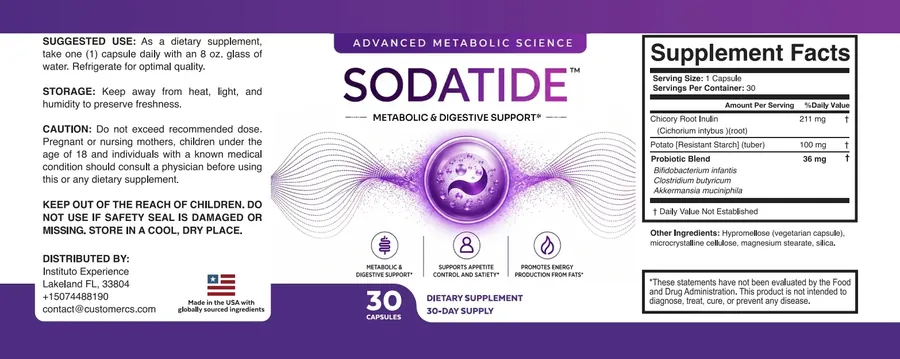
Probiotics are dosed in CFU, the number of live cells, often 1 to 10 billion per dose (NIH ODS Probiotics (HP)). A good label names the strain code and gives the CFU count at the end of shelf life. Sodatide's label lists a 36 mg probiotic blend of three species, with no CFU count and no strain codes, so its live-cell dose cannot be checked.
Written by the Sodatide editorial teamUpdated · 9 min read

The unit
What does CFU mean on a probiotic label?
CFU stands for colony-forming units. It counts the live microbes that can grow and multiply, which is the part of a probiotic that research measures.
The NIH Office of Dietary Supplements says many probiotic products contain 1 to 10 billion CFU per dose, and some contain 50 billion or more (NIH ODS Probiotics (HP)). What matters is whether the strain and dose match a study.
A count is written in a short form. "1 x 10⁹ CFU" means 1 billion live cells. "1010" means 10 billion. You will see both styles on store shelves.
Weight vs cells
Why is CFU more useful than milligrams?
Milligrams tell you how much powder is in the capsule, not how many cells are alive. The NIH notes that current rules only require the total weight of the microbes, and that weight includes dead cells (NIH ODS Probiotics (HP)).
| Label shows | What it tells you | What it leaves out |
|---|---|---|
| Milligrams (mg) | The weight of the bacteria powder | How many cells are alive, and whether any are |
| CFU at manufacture | Live cells on the day the batch was made | How many survive until you open the bottle |
| CFU at end of shelf life | The lowest count the maker stands behind | Survival in your stomach and gut |
| Nothing but a species name | The type of bacterium | Strain, count and form |
Two capsules with the same milligrams can hold very different numbers of live cells.
Strain codes
What is a strain code, and why does it matter?
A strain code is the letters and numbers after the species name. It identifies one specific line of bacteria, the way a model number identifies one car.
The NIH says probiotic effects are strain-specific (NIH ODS Probiotics (HP)). NCCIH adds that different types of probiotics may have different effects, and that for most conditions it is not known which ones help, or at what dose (NCCIH Probiotics).
One strain, three doses, one result
A trial of Bifidobacterium infantis 35624 in 362 women with IBS tested three doses. Only the middle dose, 100 million CFU, beat placebo (Whorwell 2006 B. infantis 35624 IBS). The lower and higher doses did not. That result belongs to strain 35624 at that dose. It does not carry over to other strains of the same species.
Safety can be strain-specific too
EFSA left Clostridium butyricum off its presumed-safe list because a minority of strains carry a botulinum toxin type E gene (ACNFP C. butyricum TO-A paper). One strain, MIYAIRI 588, has been used in Japan since the 1960s (Miyarisan CBM 588 novel food dossier). Without a strain code, a buyer cannot tell which kind is in the bottle.
The date that counts
Why should a probiotic label give CFU at the end of shelf life?
Live cells die slowly while the bottle sits on a shelf. A count taken at the end of shelf life is the lowest number you should get, which makes it the honest one to compare.
The NIH advises consumers to look for the CFU count at the end of shelf life, not at the time of manufacture (NIH ODS Probiotics (HP)). A label that says "at time of manufacture" may hold far fewer live cells by the time you take the last capsule.
- Best: "X billion CFU per capsule at expiration" or "through the end of shelf life".
- Weaker: "X billion CFU at time of manufacture".
- Weakest: a weight in milligrams with no CFU at all.
NCCIH also notes that some products contain microbes not listed on the label (NCCIH Probiotics).
Storage
Does storage change how many probiotic cells stay alive?
Yes. Heat, moisture and air are the main threats to live cells, so storage advice on a probiotic label is worth following exactly.
Sodatide's label asks for both a cool, dry place and the fridge: STORAGE: Keep away from heat, light, and humidity to preserve freshness. STORE IN A COOL, DRY PLACE. Refrigerate for optimal quality.
In practice, keep the closed bottle in the fridge and put the cap back on at once.
Akkermansia muciniphila is often called oxygen-sensitive. A 2020 lab study found its numbers stayed fairly high after oxygen exposure, though data are scarce (Machado 2020 Akkermansia oxygen/GI survival). No data exist on survival inside Sodatide's capsule.
The worked example
How does Sodatide's probiotic label compare?
Sodatide's label lists a 36 mg probiotic blend of three bacteria, by species only. It prints no CFU count, no strain codes and no shelf-life count. You can read the full panel on the Sodatide Supplement Facts page.
| Checklist item | What a clear label shows | Sodatide label |
|---|---|---|
| Live-cell dose | CFU per capsule | Not published |
| Strain codes | Letters and numbers after each species | Not published |
| Count date | CFU at end of shelf life | Not published |
| Amount per bacterium | Each strain's CFU | Blend total only: 36 mg |
| Storage | Clear instructions | Yes: cool, dry place; refrigerate |
| Akkermansia form | Live or pasteurized | Not published |
Blends follow FDA labeling rules: the total weight is printed and the parts are listed by weight, largest first (FDA labeling guide ch. IV). So B. infantis is at most 36 mg, C. butyricum at most 18 mg and Akkermansia at most 12 mg. Those are weight ceilings. Milligrams do not tell you live cells.
- 1Chicory root inulinChicory Root Inulin (Cichorium intybus)(root) · printed amount
- 2Potato resistant starchPotato (Resistant Starch) (tuber) · printed amount
- 3Bifidobacterium infantisBifidobacterium infantis · in blend
- 4Clostridium butyricumClostridium butyricum · in blend
- 5Akkermansia muciniphilaAkkermansia muciniphila · in blend
Listed in label order, from most to least by weight, inside one 36 mg proprietary blend per serving.
What to ask
What should you ask a probiotic brand before you buy?
Ask for the four missing facts in writing. A brand that knows its product can answer them in one email to [email protected].
The CFU count
How many live cells per capsule, and is that count at manufacture or at the end of shelf life?
The strain codes
Which strain of each species? For C. butyricum, this is a safety question as well as a dose question.
The Akkermansia form
Live or pasteurized? EFSA's safety review covered the pasteurized form only (EFSA 2021 pasteurised Akkermansia). More on the Akkermansia page.
Lab testing
Is there a batch test for counts and for unlisted microbes? The lot code SOD-26/SO-4238 is a seller reference, not a lab report.
For a wider buying checklist, see how to choose a probiotic.
Who should ask first
Who should check with a doctor before taking a probiotic?
People who are seriously ill or have a weakened immune system should ask a doctor first. The NIH reports that rare bloodstream infections from probiotics occur mostly in these groups (NIH ODS Probiotics (HP)).
The FDA has also warned that probiotics can cause serious infections in preterm infants (FDA 2023 probiotics preterm infants). Sodatide's label says pregnant or nursing mothers, anyone under 18 and anyone with a known medical condition should consult a physician first.
A probiotic is not a treatment for IBS or any disease. Ongoing belly pain, blood in the stool or a big change in bowel habits needs a doctor, not a new capsule. For side effects of each ingredient, see the Sodatide side effects page.
FAQ
Probiotic label and CFU questions
Why does the Sodatide label give milligrams, not CFU?
The label does not say. Sodatide lists a 36 mg probiotic blend of B. infantis, C. butyricum and Akkermansia muciniphila with no CFU count. Ask the brand at [email protected] for a per-capsule count at the end of shelf life.
Is a higher CFU count always better?
No. The NIH says a higher count is not necessarily better (NIH ODS Probiotics (HP)). In one IBS trial, only the middle dose of B. infantis 35624 beat placebo (Whorwell 2006 B. infantis 35624 IBS). The right strain at the studied dose matters more than the biggest number.
What does 36 mg of probiotic blend mean on Sodatide's label?
It is the total weight of the three bacteria, live and dead. FDA blend rules list parts by weight, largest first (FDA labeling guide ch. IV), so B. infantis is at most 36 mg. Weight cannot be turned into a live-cell count.
Why do probiotic labels list strain codes?
Strain codes name the exact line of bacteria that was tested. Effects are strain-specific (NIH ODS Probiotics (HP)), and for C. butyricum safety depends on the strain too (ACNFP C. butyricum TO-A paper). Sodatide's label lists species names only.
Do probiotics need to be refrigerated?
Some do and some do not; follow the label. Sodatide's label says to refrigerate for optimal quality and to keep the bottle away from heat, light and humidity. Keep the closed bottle in the fridge.
Who wrote this
Written and reviewed by
Plain-language pages built from the bottle label, the order page and linked public health sources such as NIH, FDA and CDC.
Last updated . Read our editorial standards and how we check reviews. This website is run by a U.S. retail desk for Sodatide, not by the manufacturer. We are paid a commission when you buy through our order links.
Keep reading
More about Sodatide
Choosing a probiotic
A six-point checklist for any probiotic label, with a fair scorecard for Sodatide.
Read moreSupplement Facts
The Sodatide label read line by line, plus the CFU, strain and Akkermansia details it does not print.
Read moreAkkermansia muciniphila
One 32-person pilot, a pasteurized form, and an EFSA safety opinion. What it means for Sodatide's unstated Akkermansia.
Read moreLicensed U.S. retail desk for Sodatide
Ready to try Sodatide?
Pick a pack. One capsule a day; every pack covers the whole 60-day window.
- Secure checkout
- 60-day money-back window
- Free U.S. shipping on 3+ bottles